I spent some quality time with David Sedaris a couple of weeks ago.
David Sedaris is a renown writer and humorist who has authored 12 books.
He tours regularly, reading his essays and gauging audience reactions. His book tours are famous for their long book signing lines. He enjoys chatting with each reader and often asks them questions.
David Sedaris shared how he turns observations into stories and that it often takes him weeks to find an opening sentence he is happy with.
He and I spent 3 hours and 23 minutes together.
But he has no idea who I am.
Our visit came courtesy of Masterclass.
Masterclass is an online learning platform that features celebrities and renown experts teaching courses in their specialty.
My friend Ira gifted me a 14-day guest trial pass (thanks Ira!). I took David Sedaris’s Storytelling and Humor course.
As I looked at the 14-day trial offer and entered my credit card, I noticed the annual membership was $120 per year.
I remembered it being $180 during the first year of the pandemic when Masterclass ads popped up daily in my Facebook feed.
I wondered “why would they lower their price?”
Widespread internet access and the high cost of higher education in the US gave rise to a host of online learning companies.
In 2002, Lynda Weinman shifted her educational company Lynda.com from in-person webinars to online courses featuring video instruction. Online video was new then. It took a while for students to adapt to it.
But adapt they did. Lynda.com grew to offer over 6,300 courses. Weinman sold it to LinkedIn in May 2015 for $1.5 billion.
Most of the other well-known online learning players launched between 2010 and 2012: Udemy (2010), Skillshare (2011), Coursera (2012), and Udacity (2012).
Masterclass appeared in May 2015, just as Weinman was cashing in.
Like any party late-comer seeking attention, Masterclass stands out with a key difference: celebrity instructors. Their tagline: “Learn from the best, be your best.”
Founders David Rogier and Aaron Rasmussen launched with 3 classes: Serena Williams teaching tennis; Dustin Hoffman teaching acting; and best-selling author James Patterson teaching writing.
Each instructor reportedly received $100,000 plus 30% of the revenue from their class.
Masterclass also invested in professional video production and set design for each course.
Classes sold for $90 each. Each class package included 10-25 videos, learning materials, interactive exercises (between students), and lifetime access.
Over 30,000 people bought Masterclass courses within the first 4 months.
Masterclass added dozens of courses each year and began offering annual subscriptions for unlimited course viewing at $180 in 2018, removing the $90-for-one-class option.
During the early part of the pandemic, you couldn’t go on Facebook, Instagram, or YouTube without seeing at least one Masterclass ad.
The heavy ad spending worked. Masterclass capitalized on the captive audience, doubling revenues from 2019 ($44.5 million) to 2020 ($88.9 million), and adding another $29.9 million in 2021.
But when the world reopened and people began returning to workplaces in 2022, annual revenue fell to $94.9 million, a $23.9 million decrease.
Since inception, Masterclass has raised $460 million in venture capital. Not yet profitable, the revenue backslide likely made investors antsy. Subscriptions provide all of Masterclass’s revenue.
In May 2022 the company laid off 120 of their 600 workers.
While layoffs reduced cost, Masterclass’s survival requires raising revenues which means increasing subscriptions.
Now 8 years old, Masterclass has hit brand adolescence as it struggles to grow.
In May 2023, Masterclass cut its individual annual subscription plan price by a third, from $180 to $120.
In a statement announcing the price drop, David Rogier, Masterclass Founder & CEO said, “By continuing to innovate the approach to our portfolio of content and making the platform more accessible, we’re not only unlocking potential in our members, we’re enabling them to realize it.”
I don’t know what that means.
It’s a jargon-filled declaration. Was the potential of members locked at $180?
The “more accessible” part I get. It’s the basic economic model we learned in school. You lower the price, more people buy.
I’m guessing Masterclass looked at their competitors, saw them offering free classes and cheaper individual courses (Udemy), and felt compelled to lower their subscription fee.
Antsy investors added pressure to sign more subscribers quickly.
Perhaps their smaller number of course offerings also pushed them to the lower annual fee.
But on an annual fee basis, they were already at the low end with the $180 fee ($15 per month). Now they are at the bottom.
Trying to fit in to your market arena by competing on price is a recipe for disaster.

There is a difference between having a competitive price and competing on price.
The former means your price is within the range of what your industry offers. It removes price as a differentiator so your prospect considers your brand on other factors.
The latter encourages price cutting and becomes a race to the bottom. Once you lower your price, your competitors may follow. Then what is your choice? Lower it again?
Competing on price destroys brands, especially premium ones.
Masterclass offers a premium product. Professionally produced, entertaining classes taught by recognizable experts and celebrities.
They have been challenged all along to get users who are attracted for one class to stay and take others. (This may have been behind removing the $90 one class option in 2018.)
Dropping your price doesn’t address that challenge.
Increasing your value in the eyes of your subscribers and conveying that value well do.
To do that, you need to understand your audience, their wants, and how your brand fulfills them.
A New Yorker article in October 2021 reported that Masterclass had an unusually high renewal rate of 52 percent after one year. The typical student watches 10 classes, hopping from subject to subject.
But, the article stated, the time subscribers spend watching classes does not relate to their likelihood to renew.
Masterclass doesn’t know why their subscribers renew.
In the article, Masterclass’s chief product officer says of his efforts to understand and guide subscriber behavior, “Asking them why they like a class doesn’t give you very reliable data.”
This tells me that while Masterclass may have done lots of research to get class feedback, they don’t yet know the segments of their audience well enough to know what attracts them and what makes them stay.
It is true that people have a hard time relaying why they do what they do. That’s where consumer insights gathering techniques shine, and how I’ve helped my clients.
Unearthing customers’ motivations requires creativity. You must ask the right questions to get the answers you want, and often they are not direct or obvious questions.
The only way Masterclass will surmount their brand adolescence and get into the black is to get clarity on their customer segments, understand their motivations, and craft messages and services that resonate with them.
I only managed to complete one full class before my 14-day trial ran out.
David Sedaris’ course on Storytelling and Humor gave me several tips I’ll use in the future.
His approach also made me feel good about my own. We’re both students of the world, observing often, jotting down experiences, and asking good questions.
I did not subscribe, however.
Masterclass is known as the Netflix of online learning. A binge-worthy distraction is not what I need right now!
Have you ever taken a Masterclass?
***
If you and someone you care about has a brand struggling to grow, pick up a copy of my book, Teenage Wastebrand: How Your Brand Can Stop Struggling and Start Scaling.
Or grab the audiobook here. I narrated it myself!

***
Masterclass’s ubiquity on social media platforms during the pandemic made it ripe for parody.
Andy Rowell Teaches Pooping (1 minute, 44 seconds)
Steve Emerson’s Masterclass on Daddy’s Money (2 minutes, 12 seconds)
And of course SNL delivered a Masterclass Quarantine Edition (2 minutes, 43 seconds), and another Masterclass Quarantine Edition (2 minutes, 58 seconds).
Enjoy!
The closest I’ve come to liking Elon Musk was during his SNL opening monologue on May 8, 2021.
But it was never that close.
I admired his courage to appear on the show and willingness to mock himself. His performance humanized him. He was funny in some skits.
Yet my gut told me not to trust anything he said.
Too many shoot-from-the-hip statements and impulsive acts.

One of Musk’s impulsive acts was offering to buy Twitter for $44 billion in April 2022. Twitter’s board accepted his offer. He tried for months to get out of it and haggle the price down.
Advised a court would force him to honor the agreement, he changed tunes and completed the purchase.
New leaders often assess a brand by talking to employees and customers before taking action.
Musk’s due diligence during the purchase process and management style led him to act first, think later.
On October 27, 2022, Musk’s first day as owner, he fired Twitter’s CEO Parag Agrawal and three other senior leaders, making himself CEO.
A week later, Musk laid off 3,700 employees, about half the workforce. Many employees learned of their layoff by discovering they could no longer access their company email accounts.
Just days later, company leaders were asked to compile lists of employees they would ask back, with an emphasis on media engineering. Few wanted to return.
Subsequent layoffs have whittled Twitter to 1,500 employees.
On October 30, 2022, The Verge announced Twitter was raising the monthly price of Twitter Blue from $5 to $20 and requiring verified users to subscribe or lose their coveted blue check marks.
Twitter Blue subscriptions offered top articles, custom icons, and the ability to edit tweets.
Blue check marks signaled the user had passed a stringent verification process. You could trust it was really them tweeting.
After Stephen King balked, Musk dialed the cost down to $8 on November 1.
Musk then offered anyone willing to subscribe a blue verification check mark if they provided their phone number.
A deluge of impersonators and scam artists signed up. Twitter had to halt subscriptions to regain control.
Now with little real value, many celebrities declined to subscribe to preserve their blue verified-user check mark.
In April 2023 when Twitter began enforcing the subscription requirement, Musk decided to comp subscriptions for Stephen King, LeBron James, William Shatner, and Iced T.
Every other nonsubscriber’s blue check mark vanished.
On November 18, 2022, Musk ran a poll on reinstating Donald Trump’s account. It had been banned following the January 6, 2021 attack on the Capitol. Voters narrowly agreed 51.8% to 48.2%.
Twitter restored Trump’s account on November 20, 2022.
Musk’s November 23 poll asked if Twitter should offer a general amnesty to suspended accounts. Seventy-two percent (72.4%) of the 3.2 million users who voted said yes.
Twitter began reinstating suspended accounts the following week.
On December 15, 2022, Musk, a self-described “free speech absolutist,” banned journalists Donie O’Sullivan (CNN), Ryan Mac (The New York Times), and Drew Harwell (The Washington Post) from Twitter, and other journalists who had covered his actions aggressively.
He claimed they “doxxed” him, sharing his exact location in real-time, endangering his family. No proof emerged.
After an uproar, Musk polled Twitter that same day about unsuspending the accounts. Fifty-eight percent voted for immediate unsuspension.
Twitter made the suspended journalists’ accounts viewable on December 17, but required them to remove the “offending” tweets before allowing them to tweet.
Most surprisingly, Musk’s December 18, 2022 poll asked if he should step down as CEO. Fifty-seven percent (57.5%) of the 17.5 million voters said yes.
Musk’s initial reaction was to reconsider who gets to vote in Twitter polls. After a user suggested only blue check mark holders should get to vote, Musk responded, “Good point. Twitter will make that change.”
That did not happen, however.
On December 20 Musk said he’d step down after he found a replacement.
But he began undermining his successor by saying he needed to find “someone foolish enough to take the job.”

Brands exist in consumers’ minds as the sum of their experiences.
Twitter came into being as a place to get and share breaking news. It grew into a place for influencers and followers to meet and converse.
Musk’s impulsive management, policy changes, and reversions gave users and advertisers whiplash.
Twitter and Musk delivered tons of bad experiences that eroded trust in the Twitter brand, degraded it, and prompted many users to flee.
Only 43 percent of Twitter’s top 1000 advertisers in September 2022 were still advertising there in April 2023.
For many, the Twitter brand evolved to be more about Musk and his whims than anything else.
Making good on his promise to step down, Musk hired Linda Yaccarino, NBCUniversal’s head of advertising, as Twitter’s new CEO, beginning June 5, 2023.
This pivotal moment could have saved Twitter.
If Yaccarino had shown she would address users’ concerns, restore lost functionality, and stabilize the brand, Twitter users and advertisers might have exhaled and renewed their faith in the platform.
But Musk continued to speak and act for Twitter, undermining Yaccarino.
On July 15, 2023 Musk said advertising revenues were down 50 percent and cash flow was negative.
Though CEO Yaccarino said the company was “close to break even” on August 10, 2023, onlookers remained skeptical. Musk’s July statement makes this financial recovery questionable.
On July 23, 2023 Musk announced he was rebranding Twitter as X. He tweeted a request for proposed logos, chose one, and implemented it the next day.

Musk envisions X as an “everything app,” enabling users to make payments, get news, and order food, among other things.
X CEO Yaccarino tweeted about the new brand but it appears Musk is still leading it.
Some long-time Twitter users and influencers with substantial followings are hanging on.
The value they derive from X still outweighs the uncertainty, reduced visibility, and decrease in functionality.
But their patience won’t last forever. It’s waning for some already.

Ann Handley (@MarketingProfs, 453,900 followers) told me, “…I've been spending less time [on Twitter] in the months leading up to the rebrand...But I will say that I have been enjoying [X’s new competitor] Threads.”

Mark Schaefer (@MarkWSchaefer, 167,700 followers), author of The Tao of Twitter, said: “I've learned to navigate Twitter, er ... X, in a way where I experience minimal dysfunction. Follow the good people, block the haters, rinse and repeat. I observe and comment lightly. Not too much discourse these days.”

Arvid Kahl, (@ArvidKahl, 120,300 followers), creator of Find Your Following, a Twitter blueprint, said: “It frustrates me that a platform like Twitter that lives and breathes by the work of the people who use it can be intentionally and violently devalued by leadership like this.
“There are many things Musk could have focused on. Rebranding a beloved name wasn't one of them. I still love the community on there. Just not the fact that it is now X.”

Julie Van Ameyde, (@SimplySocialMI, 1,057 followers) owner of Simply Social Media, LLC, said: “For me, the most significant difference is the ability to monitor Twitter for clients on Agorapulse…I am now back to manually monitoring 15 Twitter accounts and their brand mentions/keywords, causing me to waste the time I need.
I also find it interesting that many automotive OEMs abandoned Twitter/X almost overnight when the Musk transaction was complete.”

Dhariana Lozano, (@DhariLo, 22,900 followers) Social Media Consultant and Speaker, told me: “I'm not the happiest about it [changes to Twitter/X]…My biggest concern is…it seems to be heading in a very ‘pay to play’ direction and I don't like that.”
Musk has made it harder for these influencers to enjoy the X platform and use it efficiently. That’s a recipe for contracting a brand, not expanding it.
From a strict renaming point-of-view, Twitter’s rebrand to X is at best premature.
Rebrands signal major changes. Musk intends those. But his changes remain aspirations.
Musk has tossed Twitter’s towering brand equity in favor of his beloved X with no strategic gravitas to show for it.
Meanwhile the platform’s real problem is eroding trust.
The name change seems to have expedited the erosion. I ran a poll on LinkedIn asking Twitter users how the rebrand to X affected their trust of the brand.
Of the 50 Twitter users who responded, 26 said they trust X less than Twitter, and 10 said they had left Twitter.
Though not statistically significant, the results flash like the early evening iceberg warnings the Titanic ignored.
To turn this ship, X needs:
To tame Musk. His impulsive acts drained his credibility, and took Twitter down with him. Though he installed Linda Yaccarino as CEO to help win advertisers back, his prominent voice continues to undermine her and the X brand.
To build on Twitter’s essence. Twitter began and grew as the place to get live news. While X may not be able to lure defectors back, keeping users who loved Twitter would be easier if they still felt that lure.
This means taking steps to ensure news is easy to find and reliable.
To talk to users and address their concerns. Management must understand users’ and advertisers’ concerns and address them to demonstrate they care. Policies and features need to encourage use of the app, not make it harder or waste users’ time.
To take cues from users. No one switched to x’s instead of tweets. Users are still saying tweets, and that term differentiates the X platform from other social media. Go with that!
To be transparent. Though Musk’s purchase makes the company private, advertisers and influencers don’t want to invest in a brand with a questionable future. Transparency about usage, finances, and issues they are addressing is the only way to restore credibility.
To rebuild trust. X may aspire to be an “everything app,” but why would someone who doesn’t trust the platform for social media use provide personal payment information? They won’t.
Before expanding, X needs to regain the trust from key constituencies and get people to want to spend time on their app.
It’s a tall order. Do you think X can succeed?
***
Don’t let your brand make Twitter’s mistakes. Hear about good brand practices as Matt Lyles and I chat about them on his SIMPLE brand podcast. We discuss:
Listen (36 minutes, 58 seconds) and get show notes here.

Watch Elon Musk’s SNL monologue. (5 minutes, 36 seconds)
Some brides get superstitious before their wedding. Luckily that’s not me.
Dan and I got married in June 1994. On the Friday that kicked off our wedding weekend, the US began hosting World Cup Soccer for the first time.
At the opening ceremonies in Chicago, host Oprah Winfrey fell off the stage. Diana Ross pulled a penalty kick left, but the goal posts had been rigged for drama and split open anyway.
Those weren’t even the weirdest events that day.
They were eclipsed that evening by OJ Simpson as he led the LA police on a low-speed highway chase in a white Ford Bronco. Thirty-five miles per hour and yet the chase went on for 60 miles.
Despite these oddities, our wedding went smoothly that Sunday. On Monday we left for a two-week honeymoon in Greece.
And when we returned, Federal Express as we knew it was gone.
Every company truck, plane, package, and envelope from the former Federal Express now said FedEx.

It was weird, but easy to understand. The verb “to fedex” had been in our business lexicon for a few years by then.
What a quick transformation the company pulled off. They timed it to happen overnight on June 24, 1994.
You can imagine the amount of money, time, and effort they spent to orchestrate that.

Why would they do that though? The company was growing and business was good.
When Fred Smith launched Federal Express in 1973, nationwide overnight delivery seemed like a pipedream. The concept was so farfetched that Xerox shipped empty boxes for two weeks before entrusting them with document-filled ones.
The initial job of the Federal Express brand was to represent speed and reliability. Hence the tagline “When it absolutely, positively has to be there overnight.”
Creative approaches to emphasizing their speed resulted in entertaining commercials starring fast talker John Moschitta.
People frustrated with the United States Postal Service (USPS) – the only other option at the time – began to give them a try.
By the early 1990s, with their reliability and speed established, Federal Express was going global.
Meanwhile, competitor Emery had copied Federal Express’ model by getting their own planes.
Airborne Express entered the small package air express business.
The USPS began pushing their own overnight delivery service.
United Parcel Service (UPS), the largest shipper via trucks, entered the air shipping business. DHL Worldwide Courier Express Network replicated Federal Express’ US model overseas.
Though business was still growing, Federal Express found itself as a brand in adolescence with lots of competition.
American high schools offer teenagers the opportunity to compete in sports by fielding their best athletes on a team they designate as Varsity.
High schools often combine students from several different areas of a city or town. Many students who played a sport in elementary and middle school find themselves vying for the few spots on the high school varsity team.
Brands in adolescence can face similar competition.
When Federal Express began, they were the only overnight option. As their success grew, competitors flooded in.
Like teenagers trying to impress a coach for a spot on the varsity team, Federal Express now tried to stand out in a crowded field for their customers’ consideration.
I call this brand adolescence symptom defending your varsity team spot.
Federal Express’s overnight transformation to FedEx turned out to be the culmination of two years of research and rebranding work.
Both the name change and the logistics feat reminded customers and the public that they personified speed and reliability.
But FedEx did not stop there.
In their research, FedEx no doubt heard that even with their brand promise, customers were anxious about packages arriving on time while they were in transit.
FedEx looked for ways to deepen their relationship with customers by allaying their anxiety.
They built a proprietary tracking system so customers could not only have faith that the brand would deliver on time, they could get proof of where their package was in the process.
Their tracking option proved highly desirable among customers and differentiated them from rivals.
FedEx also created the first automated package shipping system for PCs and, in the mid-1990s, was one of the first companies to enable business-to-business transactions on its website.
Noting their customers’ international business dealings, FedEx expanded overseas, becoming authorized to serve China in 1995. Through an acquisition from Evergreen International Airlines, they became the sole US cargo-only carrier with aviation rights to China.
In February 2004, FedEx bought privately-held Kinko’s (a document-copying and business-services store chain) and branded them FedEx Kinko’s (and, in 2008, FedEx Office), giving the brand 1,200 outposts to expand their reach to customers and make it more convenient.
FedEx maintains their lead in the overnight shipping industry by constantly looking for ways to enhance their customers’ experience.
How do know if you need to defend your brand’s varsity team spot?
Here are some telltale signs:
1. Your marketplace has become crowded.
If your brand launched into a “white space” – a gap in the marketplace where customers’ needs were not met – your success may have attracted many competitors.
While Federal Express founded the overnight delivery industry, they had plenty of competitors offering the same service twenty years later.
2. Your purpose no longer differentiates your company.
Overnight delivery was a unique – and outlandish – purpose initially. By 1994, it no longer distinguished Federal Express from its competitors.
FedEx broadened its purpose to include logistics to set themselves apart, and announced that by flipping the switch on their rebrand.
Spotify initially focused on allowing listeners to stream music legally. Once that space became crowded, Spotify CEO Daniel Ek revised their purpose to focus on supporting creativity and acknowledge both their user and artist audiences.
3. Your brand attributes have become category attributes.
Speed, reliability, and overnight set Federal Express apart in its early years. Now all players in the industry must have those to compete.
FedEx’s rebrand and continued evolution have added logistical expertise, peace of mind, and convenience to distinguish them from the pack.
If your brand’s dominance in your niche has eroded, you’ll need some strategic work to reassert your market leadership.
Clarify your brand identity and evolve if needed. Has your purpose become commonplace, like Federal Express’s overnight pledge had?
Have your brand attributes become category attributes like speed and reliability did for Federal Express, no longer differentiating them?
Conduct research among your audiences (customers, partners, employees) to rediscover why they come to you and what current needs remain unmet.
See where you can serve them in new and unique ways. Revise or update your purpose and attributes if needed.
Deepen your brand’s relationship with your audience by doubling down on your niche. Through research and conversations with your audience, continue to build your knowledge about them and seek to understand them more than your competitors.
Use your knowledge to serve your customers better than your competitors. FedEx discovered their customers were still anxious about their packages in transit, which led to their tracking system creation.
Address not only the functional needs of your audience but the emotional ones too. The peace of mind FedEx’s customers felt when they were able to see exactly where their package was catapulted the company back to the go-to shipping choice.
For more on how to defend your brand’s varsity team spot, check out Teenage Wastebrand: How Your Brand Can Stop Struggling and Start Scaling (Chapter 8).
By initiating the overnight shipping industry, Federal Express had the market to themselves for a while. But success attracts competitors, and the honeymoon ended.
It is worth noting FedEx’s 1994 rebrand was not just cosmetic but reflected real strategic changes in the company. Companies that just change their logo and don’t revitalize their brands don’t boost business.
FedEx has worked hard to maintain their market leadership and capitalize on their OG shipping stature. (OG is original gangster, for those old enough to have used FedEx in their early years.)
These days Amazon is among their toughest competition. Once the new-niche honeymoon ends, it rarely comes back.
Happily, my honeymoon continues…going on 28 years this June!
***
The wedding industry is booming now, as many who postponed their wedding early in the pandemic are getting married this year. Resources for the big day can be hard to find.
If you have a need to officiate a wedding for a friend or family member, Miller Lite and the Universal Life Church would like to help. See how to get ordained here.
Hat tip to Rohit Bhargava for noting this in his Non-Obvious Insights Newsletter.
Likewise, many people who postponed vacations have trips planned now.
Check out this SNL insightful commercial about what vacations can and cannot do for you.
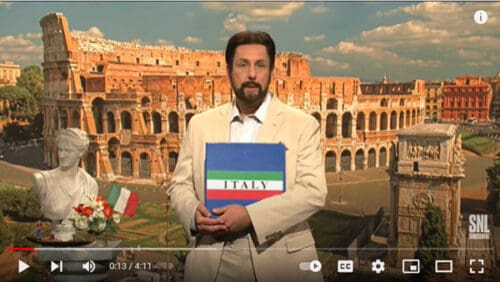
Thanks to Austin Kleon for tweeting about this.
Every summer I go berry picking at least once.
This year my husband and I picked blueberries on an August Saturday at Tougas Farm in Northborough, Massachusetts.
During the two hours we were in the field, I reveled in the berry-picking crowd.
Entire families picked berries together.
Parents with toddlers chatted with them as they picked, asking questions about what they were seeing. Their banter warmed my heart.
Strangers smiled at each other. Conversed.
No one was on their phone.
No one rushed.
Everyone spent several minutes picking from an individual blueberry bush before moving on.
What a serene and focused atmosphere.
It wasn’t just that it was Saturday or a sunny August day.
People were deliberate and unhurried because berry picking rewards patience.
Blueberries are small. It takes many to fill a quart container.
That can be daunting when you get to the field and see the first photo below.


At first, green leaves dominate your view. Few ripe berries appear initially, perhaps the three circled in red in the picture above.
If you rush, you pick those three and move to the next plant.
If you study the plant, you see several berries in the background, partially obscured by leaves, where the red arrows are in the picture above.
Looking closely multiplies your berry opportunities. If you move the leaves near those red arrows, you find clusters of berries where only a few were visible initially.
And if you stay long enough to move aside leaves where berries were not visible, like in the yellow rectangle section of the picture above?
Look what you could find:

Patience allows you to see what others miss. Rushed pickers don’t push aside inner leaves. They forget to look up or crouch down.
Ironically, rushed pickers spend longer and expend more energy collecting berries than those who take time to explore the plant in front of them.
The tenets of good berry picking apply to developing a niche for your business.
Powers of observation, assessment, patience, and care all come into play.
Like approaching a blueberry bush, it takes time to get insights into a niche market.
Prospects need to know, like, and trust you before they will buy from you. Many won’t reveal themselves until they have observed and assessed your brand.
You need to build relationships with them.
Rushing the sale before your prospect is ready can turn them off. Like an underripe berry carelessly picked, your relationship may never ripen to the point where your prospect becomes a customer.
It takes self-discipline to wait until the right moment to make your offer.
As experienced pickers can return again and again to a few bushes to fill their containers, business owners who invest in developing a niche can find it will sustain their business for years.
Not every business owner has the patience and self-discipline to develop a niche.
Many business owners fear a niche won’t be big enough to support their brand’s growth.
The time niches take to germinate stokes that fear.
But if you can weather the initial years it takes to establish your brand’s niche, it can pay off for decades.
Examples abound.
Founded in 1980, Whole Foods focused on organic food before it was fashionable and operated in Austin, Texas for four years before expanding to the Houston area. When the company went public in 1992, it had 12 stores across four states: Texas, California, Louisiana, and North Carolina.
When Amazon purchased Whole Foods in 2017 for $13.7 billion, the company had 460 stores, presence internationally, and 87,000 employees.
Powell’s Books has focused on selling used and new books in Portland, Oregon for 50 years. Their annual revenue has grown to $111 million and they are a third-generation family-owned company.
Furniture by Penn has provided handcrafted, custom-made furniture made from sustainable materials to customers in Southern Ireland for 48 years.
Vermont Wooden Toys has produced local wood products for 51 years. Despite an outdated website, no social media marketing, and only recently accepting credit cards, orders are still booking four months out.
Kerrygold has sold milk products since 1962. A global Irish brand, Kerrygold hit revenues of €1.3 billion in 2020. Their butter is the top seller in Germany and the number two brand in the U.S. I enjoy their Dubliner cheddar cheese.
Vineyard Vines began their preppy vacation-wear company by selling colorful, irreverent, island-inspired print ties on Martha’s Vineyard in 1998.
They crossed the $1 million sales mark in three years, helped by a $400,000 order from Aflac for ties with their iconic ad campaign duck. Dun & Bradstreet estimates their current sales a $1.5 billion.
A niche is a sustainable business strategy and among the best ways to differentiate your brand. Every brand above is well-known for their niche and a go-to for their target audience.
They became known through years of commitment to their niche.
Do you have the patience to develop your niche?
Take a page from their play book and that of expert berry pickers.
Survey the terrain. Assess your potential niche like an experienced picker would choose a blueberry bush.
How big is the market? Who are the players? What does the target audience seek? Does your brand offer something truly different and desired?
Choose an ample-sized, underserved niche where your offering is unique. Ample means big enough to help your brand grow for at least several years.
Kerrygold’s butter and cheese get their unique flavor from cows’ milk enhanced from the cows’ consumption of Ireland’s rich and sweet grass. That’s hard to replicate.
Look beyond the obvious. Just as you need to get close and move leaves to see the true bounty of a blueberry bush, your niche knowledge gathering requires deep insights.
Talk to customers about the circumstances that prompt them to seek your brand, the ways they use your offerings, the experience they have buying from you. Identify opportunities to serve them better and improve their outcome.
Powell’s launched their website and began selling books online in 1994, a year before Amazon and three years before Barnes & Noble starting selling online.
Demonstrate your commitment. Speak specifically to your ideal customer in your marketing. Show them you understand their challenges, that your brand can deliver their desired outcome. Adapt as your customers’ needs evolve.
Vermont Wood Toys honored their buyers’ desire for all-natural products when they stopped using external stains and sealers in 2015.
Vineyard Vines features their employees and customers on their website as the “Real Good People” part of their “Our Story” page.
Be patient. Build relationships. Get to know your target market by taking a genuine interest in them and connecting with them often. Gain their trust. Focus on serving them long term.
Repeat business is cheaper to gain, more profitable, and more fulfilling than a succession of one-time sales. Like expert blueberry pickers who fill their containers over and over from a few abundant bushes, your patience will be rewarded.
Furniture by Penn aims for this explicitly: “By specialising in lifelong customer relationships, Furniture by Penn thrives to support you at every step of your home making journey.”
It’s easy to envision your brand bursting on the scene and growing exponentially.
Sometimes that happens. More often brands take off after years of community building to establish themselves and their niche.
They just have the appearance of overnight success because by the time you’ve heard of them, they’ve been spreading the word long enough to reach you and reached many others in the process.
Vineyard Vines was like that for me. They started in Massachusetts, where I’ve been living since 1987. But I only heard of them sometime in the late 2000s, after they’d been in business 10 years.
When viable niches fail, it’s likely that brands failed to commit to them or abandoned them prematurely.
Like rushed berry pickers, they either covered too much territory (not committing) or moved on too fast.
If you can be patient, focus, and build relationships, you can set your brand up for long-term success and own your niche.
What’s your favorite niche brand?
***
Blueberries are native to North America. In addition to being delicious, they have shown up in American pop culture.
How many of these blueberry references can you name?
Give it a go. You can find the answers here, with a few accompanying videos.
Enjoy!
1 - Who sang “Blueberry Pie” on the Sesame Street album In Harmony?
2 - What’s the name of the character in the 1971 film Willy Wonka & the Chocolate Factory who blows up like a blueberry?
3 - Who sang the most well-known rendition of “Blueberry Hill”? .
4 - Who was the first to record “Blueberry Hill”? .
5 - What TV character broke into a rendition of “Blueberry Hill” when he thought he was about to get lucky? .
6 - What’s the name of the blueberry-flavored General Mills cereal introduced in 1973?
7 - What video game has a setting in a town called Blueberry?
8 - What band has a famous bootleg recording from it “Live on Blueberry Hill” concert?
9 - Name any one of the performers in the 2007 film “My Blueberry Nights.”
Bonus question: What is the name of the European berry closest to the blueberry?
Check your answers here.
After spending the winter of 2021 producing my book and the early spring getting it into the world, I needed a fun break.
Don’t we all?
Instead, I decided tackle one of the biggest brand dilemmas of the year.
Who should host the quiz show Jeopardy!?
If you haven’t been watching or somehow haven’t heard, Alex Trebek, host of the show in daily syndication for 37 years, passed away on November 8, 2020 at age 80 after a battle with pancreatic cancer.
His passing added to the upheaval we’ve experienced since March 2020 for many Jeopardy! fans.
His last show aired on January 8, 2021.
Since January 11, 2021, the show has been running a sequence of guest hosts.
Replacements have included broadcast journalists Katie Couric and Anderson Cooper, Mike Richards (the show’s executive producer), Aaron Rodgers (Green Bay Packers’ quarterback), and Ken Jennings (winningest contestant in Jeopardy history).
The parade-o’-guest-hosts has been amusing and is scheduled to continue through at least mid-August 2021.
Just as life will never be quite the same post-pandemic, Jeopardy! will never be the same without Alex Trebek.
To move forward we must all find our “next normal.”
Jeopardy! fans’ next normal includes a new, regular, well-chosen host.
Both the parade of guest hosts and uncertainty surrounding the future permanent host suggest to me that the Jeopardy! brand was unprepared to lose Alex and is feeling somewhat lost now.
Let’s help them out, shall we?
The Jeopardy! brand was born in 1963 on a plane during a conversation between entertainment mogul Merv Griffin and his wife Julann about the quiz show scandals of the 1950s.
Merv wanted to create a new quiz show but feared the scandals showing the outcomes had been fixed had tainted the format’s credibility.
Julann jokingly suggested Merv give the contestants the answers.
After Julann tossed Merv “5280 feet” (“How many feet in a mile?”) and “79 Wistful Vista” (“Was that Fibber McGee and Molly’s address?”), he jumped on the idea.
I had no idea who Fibber McGee and Molly were before my research.
Art Fleming hosted the NBC and weekly syndication versions of Jeopardy! from 1964 to 1975 and from 1978 to 1979.
By the time the show was revived in 1984, the brand was 20 years old.
You could argue the brand was in adolescence then, attempting to regain its footing by shifting from weekly syndication to daily, instituting a digitized game board, and replacing Art Fleming with Alex Trebek.
The story of how Alex Trebek got the hosting job is less brand redirection and more opportunistic moment.
One night while Chuck Woolery was hosting Wheel of Fortune, he was hospitalized and Trebek filled in last minute. Wheel of Fortune was also a Merv Griffin creation. Griffin liked Trebek’s seamless performance and offered him Jeopardy!
A Sports Illustrated article from 1989 stated there were Jeopardy! purists who still regarded Fleming as “the authentic Mr. Know-It-All,” and that he was accosted frequently to answer fans’ trivia questions and settle answer disputes.
Clearly Sports Illustrated considered its purview akin to the corresponding Trivial Pursuit category at the time, “Sports and Leisure.” How much athleticism is there to ringing that buzzer?
Alex Trebek will always be the original host for those of us who started watching when the show was revived in 1984.
Art Fleming described Jeopardy! as “one big party game” and “an entertaining way to fill up 30 minutes, but basically fluff.”
In his 37 years of hosting, Alex Trebek became the face of Jeopardy! and put his own take on the brand.
On the Jeopardy! website, he is quoted as saying “I think what makes Jeopardy! special is that, among all the quiz and game shows out there, ours tends to reward and encourage learning.”

The dozens of Jeopardy! templates offered to teachers on the internet support that notion. Teachers use the game to engage students and help them self-assess their mastery of a subject.
Jeopardy! won a 2011 Peabody Award, the first bestowed on a television quiz show in more than 50 years. Given in 2012, the citation said the award was “for decades of consistently encouraging, celebrating and rewarding knowledge.” It called the program “a model of integrity and decorum.”
Successful brands don’t happen by accident. They succeed by design.
This design includes three key elements which serve as guiding forces for the brand.
The first two elements – the purpose and the personality – constitute the brand’s identity.
Based on the hosts’ comments, the Peabody award citation, and my own experience watching the show for decades, I’d describe the Jeopardy! brand purpose as to entertain and educate by testing knowledge of trivia.
Jeopardy!’s brand attributes strike me as fun, educational, intellectual, and knowledgeable.
Jeopardy!’s values, which guide the behavior of the brand team including the writers who craft the questions, include integrity, decorum, research-based facts, verification, accuracy, and fairness.
Together Jeopardy!’s purpose, attributes, and values provide a context for everything the brand does, including selecting a new host.
The new Jeopardy! host needs to embody the brand.
It’s a tall order to be fun, entertaining, intellectual, knowledgeable, and well-behaved. Even taller to be a model of integrity.
Not every guest host has filled the order.
Amanda Hess noted in her article in The New York Times that guest hosts have fallen into four categories: Jeopardy! champions, celebrity doctors, news anchors, and jocks.
The division of labor is not even among the categories.
According to the posted schedule, eight news anchors/journalists will get a chance to host. They occupy half of the hosting spots.
The other half includes two champions (Ken Jennings and Buzzy Cohen), two celebrity doctors (Mehmet Oz and Mayim Bialik), two jocks (Aaron Rodgers and Joe Buck), plus executive producer Mike Richards who has hosted other shows, and actor LeVar Burton.
I understand the bias toward news anchors for their integrity, intellectual poise, and knowledge. The fun factor among them? A yawn so far.
Dr. Mehmet Oz’s participation prompted a group of former contests to write a letter in protest, as the doctor’s personal brand attribute of pseudoscience clashed with “a show that values facts and knowledge.”
Dr. Oz’s hyping of hydroxychloroquine as a COVID-19 remedy on FOX news was among the more recent in his history of questionable pronouncements.
Amanda Hess advocated for Ken Jennings or Aaron Rodgers among the hosts that have appeared so far.
Jennings was pleasant.
Aaron Rodgers started out a bit stiff but then seemed to relax and enjoy the show, especially in this personal moment.
No one has stood out yet as the aha! moment choice.
There is great anticipation for the last week in July. LeVar Burton will host.
Burton is an actor, producer, educator, and author whose credits include playing Kunta Kinte in Roots, host and producer of PBS’s Reading Rainbow for 23 years, and playing Lieutenant Junior Grade Geordi La Forge in the television series Star Trek: The Next Generation as well as in movies based on that series.
Burton was not on the initial schedule, but producers may have been compelled to include him after Joshua Sanders started a petition for him to host.
As of this writing, the petition 254,078 signatures.
Why have more than a quarter of a million people signed this petition?
Burton’s unbridled enthusiasm for reading, learning, and truthful storytelling has shone through in every role, podcast, video, and book he has created.
In other words, he checks every box in the Jeopardy! brand.


The host the Jeopardy! producers choose will determine how the show fares going forward. With such a large franchise, it is understandable the decision would seem risky.
While it is unlikely the producers will please everyone, by using the brand’s clearly defined guidelines they have a good shot at pleasing most of their audience and setting the brand up for a bright future.
I hope you can see by Jeopardy!’s example that brands aren’t just nice-to-haves for marketing. They underlie everything your organization does and how it serves your audience.
Brands provide a foundation you can rely on when facing major decisions like replacing a beloved front man after 37 years.
Have you determined your brand’s purpose, attributes, and values and shared them with your organization?
And who would you like to see as the new regular host of Jeopardy!?
P.S. If you haven’t defined your brand’s purpose, attributes, or values yet, you can find detailed step-by-step guides in my book Teenage Wastebrand: How You Can Stop Struggling and Start Scaling. Or you can call me for help.
P.P.S. LeVar Burton has my vote!
Liz Solar is a voice talent who has been heard in everything from TV commercials to documentary and audiobook narration to animation. I was honored to be a guest on her Embark podcast recently.
We had a fun and wide-ranging conversation about how:
You can listen here.

On February 28, 1984, about seven months before Jeopardy!’s Alex Trebek era began, Weird Al Yankovic released his second album of parody songs including “I Lost on Jeopardy.” The song is hilarious. For the full experience, pause the video to read each of the clues.

You can listen to the song that inspired Weird Al’s parody, “Jeopardy” by Greg Kihn, who makes a cameo in Al Yankovich’s video.
Inspired to try out for the show? Go here to take the Jeopardy! anytime test.
Or peruse the final jeopardy questions for the last 30 years here.